How to Choose a Winning Investment Property in Batumi
Most investors focus on the wrong things first.
They fall for sea views. They compare square metres. They pick the building that looks most impressive in the brochure.
And then they wonder why their returns do not match the pitch.
The properties that consistently deliver in Batumi — year after year, regardless of market cycles — have a specific set of things in common. None of them are immediately visible in a sales presentation. This guide tells you what they are.
1. Location Is Not Just "Near the Sea"
You have heard it a thousand times: location, location, location. But in Batumi, location is more nuanced than simply being close to the water.
There are three location questions that actually matter:
Which district? Batumi has distinct micro-markets — the historic Old Town, the New Boulevard strip, the Gonio coastal corridor to the south, and suburban areas like Makhinjauri and Chakvi. Each has a different tourism profile, rental demographic, and growth trajectory. A beachfront apartment in a less-visited suburb will not outperform a well-managed property in a high-footfall tourist zone, even if the price difference seems to favour the suburb.
First coastline or second? There is a meaningful difference in rental demand between properties on the first coastal line — directly fronting the sea — and those one or two streets back. For short-term rental income specifically, guests pay a premium to wake up near the water. That premium shows up directly in your occupancy rate and nightly rate.
What is being built around it? A neighbourhood that looks underdeveloped today may have several large projects under construction nearby. Buying early in an area with confirmed infrastructure investment — roads, hotels, retail — is how the strongest capital gains are made. Conversely, a polished location with no room to grow offers limited upside.
"The best location is not the most beautiful one today. It is the one with the most momentum."
2. On-Site Infrastructure: The Occupancy Multiplier Most Investors Overlook
This is where the difference between 10% and 14% annual returns is actually made — and most investors miss it entirely because it does not show up in the price comparison.
Think about it from the guest's perspective. When someone is choosing between two apartments at a similar price point in Batumi, they are not reading the legal documents. They are looking at the photos. And what they are really asking is: will I have a good time here?
A property inside a well-equipped resort complex answers that question before the guest even arrives.
Private beach access. In a coastal market like Batumi, this is not a luxury detail — it is a direct occupancy driver. Guests pay a measurable premium to step off their terrace and onto a managed beach. Properties without beach access are competing on price, which compresses your nightly rate and your margins.
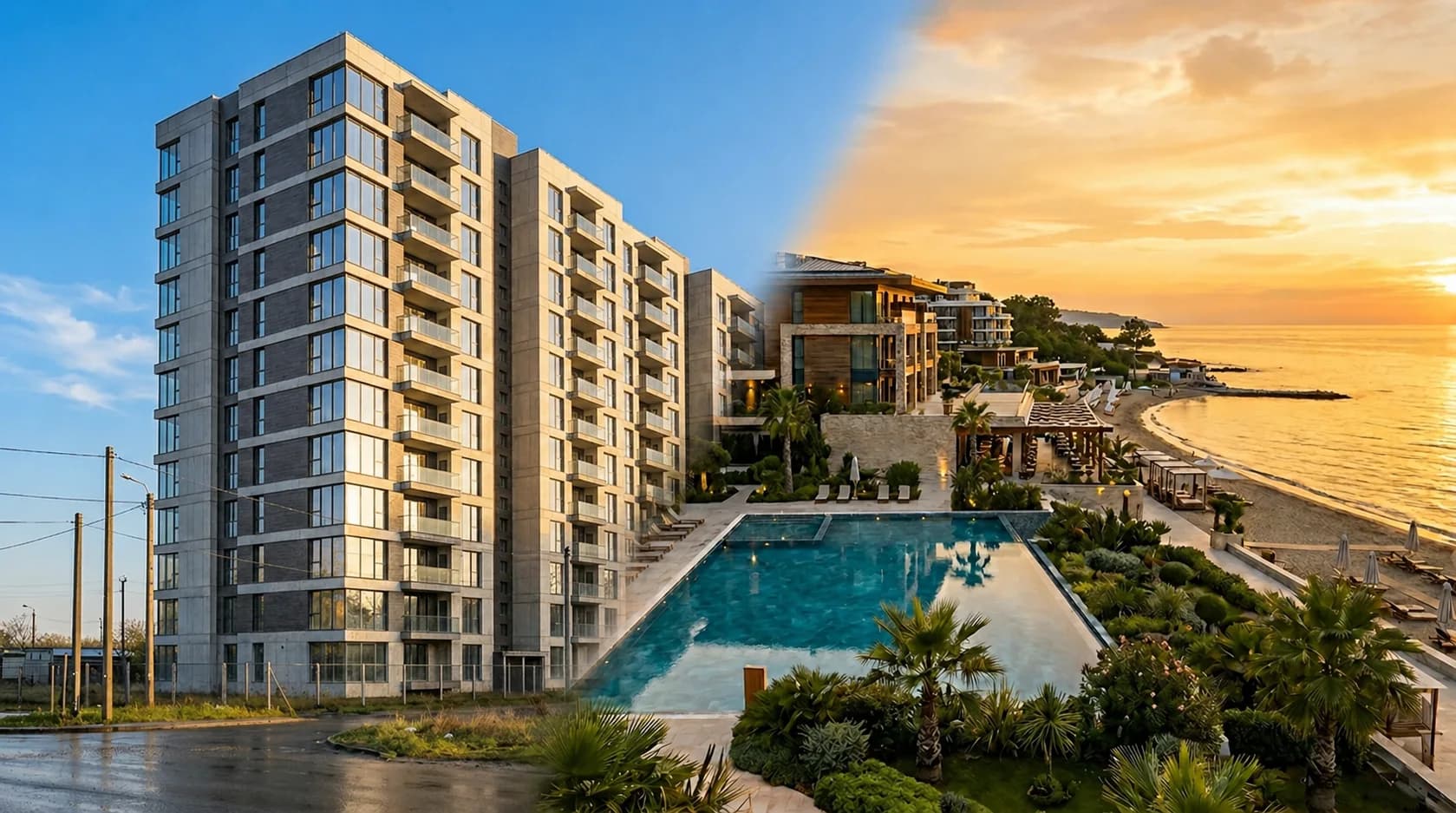
Pools, spa, and fitness. These are the amenities that appear in every booking platform search filter. A property with a rooftop pool and spa photographs better, ranks higher in search results, and commands premium positioning compared to a bare residential tower — even if the apartment itself is identical in size and finish.
Restaurants, bars, and on-site dining. A guest who can have breakfast downstairs, drinks by the pool, and dinner without leaving the complex stays longer, spends more, and leaves better reviews. Better reviews mean higher organic ranking on booking platforms, which means lower dependency on discounting to fill rooms.
Casino and entertainment facilities. In Batumi's market specifically, casino access is a genuine draw for a significant segment of high-spending guests. Developments that integrate entertainment infrastructure attract a visitor profile that books more nights and returns more frequently.
The "city within a city" model. The most compelling investment-grade developments in Batumi today are not just buildings — they are self-contained destinations. Marina access, retail, schools, co-working, multiple dining concepts, landscaped grounds. When a guest has no reason to leave the complex, occupancy becomes stickier and less dependent on the surrounding neighbourhood's development stage.
The underlying principle: every amenity that keeps a guest on-site is an amenity that improves your review score, your repeat booking rate, and ultimately your annual yield. A well-amenitised resort development is not selling you a lifestyle — it is selling you a structural occupancy advantage.
"Two apartments. Same city. Same size. Same price. The one inside a full-service resort complex will outperform the standalone building every single year."
3. The Management Company: Your Most Underrated Decision
This is the factor most investors underestimate — and the one that has the largest impact on actual returns.
A property is only as good as the team running it. The management company determines your occupancy rate, your guest reviews, your maintenance costs, and ultimately how much money lands in your account at the end of the year.
What to look for:
Track record. Has the management operator delivered returns on comparable projects before? A company managing its first property is a risk. An operator with 20 or 30 hotels under their belt has systems, distribution channels, and the ability to fill rooms even in off-peak months.
Brand affiliation. Hotel-branded developments — managed by internationally recognised hospitality operators — benefit from global booking platforms, loyalty programmes, and brand recognition that independent operators simply cannot replicate. A globally branded residence in Batumi is competing for the same guests as that same brand's properties worldwide.
Guaranteed income vs. revenue share. Some management arrangements offer a guaranteed annual return regardless of occupancy. Others offer a percentage of actual revenue. Understand exactly which model applies — and what happens if occupancy falls short of projections.
Transparency. Can you see the occupancy data? Will you receive regular statements? Are the management fees clearly defined? A trustworthy operator welcomes these questions. One who deflects them is a warning sign.
4. Developer Credibility: Who Is Actually Building It
A beautiful render is not a building. Before committing to any off-plan property, investigate the developer behind it.
Completed projects. The most reliable predictor of a developer delivering on time and on spec is whether they have done it before. Ask to see completed buildings. Visit them if possible.
Financial stability. An undercapitalised developer is a risk even if the project looks compelling. Signs of financial strength include institutional backing, international brand partnerships, or a significant volume of pre-sold units.
Delivery track record. In markets like Batumi, delays happen. The question is whether the developer communicates transparently and has a history of managing through delays without leaving buyers exposed. International hotel brands partnering with developers add another layer of accountability — they have their own reputations to protect.
Legal clarity. Is the land title clean? Is the permit in order? Has the project been reviewed by an independent legal team? These are not optional questions.
5. The Numbers: What You Are Actually Buying
After all of the above, the financial structure matters.
Entry price vs. comparable completed units. Off-plan pricing should be meaningfully below the expected value at completion. If the discount is negligible, the risk-reward profile is poor.
Payment plan. Interest-free instalment plans — common in Batumi — allow you to spread payments across the construction period without borrowing at commercial rates. This significantly improves the effective return on capital deployed at any given point.
Projected yield vs. guaranteed yield. Be precise about what is being offered. A "12% ROI projection" and a "12% guaranteed return" are very different things. Both can be legitimate — but they carry different risk profiles and should be evaluated differently.
Exit options. Can you resell before or after handover? Is there a secondary market for this type of property? A strong asset in a liquid market is worth more than a strong asset you cannot sell.
The Checklist
Before signing anything on a Batumi investment property, run through this:
- Is it on the first coastline, or in a high-footfall district with growth momentum?
- Does the location have strong existing infrastructure — transport, dining, beach access?
- Does the development have quality amenities that support premium nightly rates?
- Who is managing it — and do they have a verifiable track record?
- Is the management arrangement clearly defined, with transparent reporting?
- Does the developer have completed buildings you can point to?
- Has the project been through independent legal verification?
- Is the entry price at a meaningful discount to expected completion value?
- Is the payment plan interest-free?
- Is the projected return realistic — and what portion, if any, is guaranteed?
A property that scores well across all ten points is rare. But it exists — and it is exactly what a good property advisor is for.
Browse our current selection of legally verified investment properties in Batumi — each one assessed against the criteria above before it reaches you.